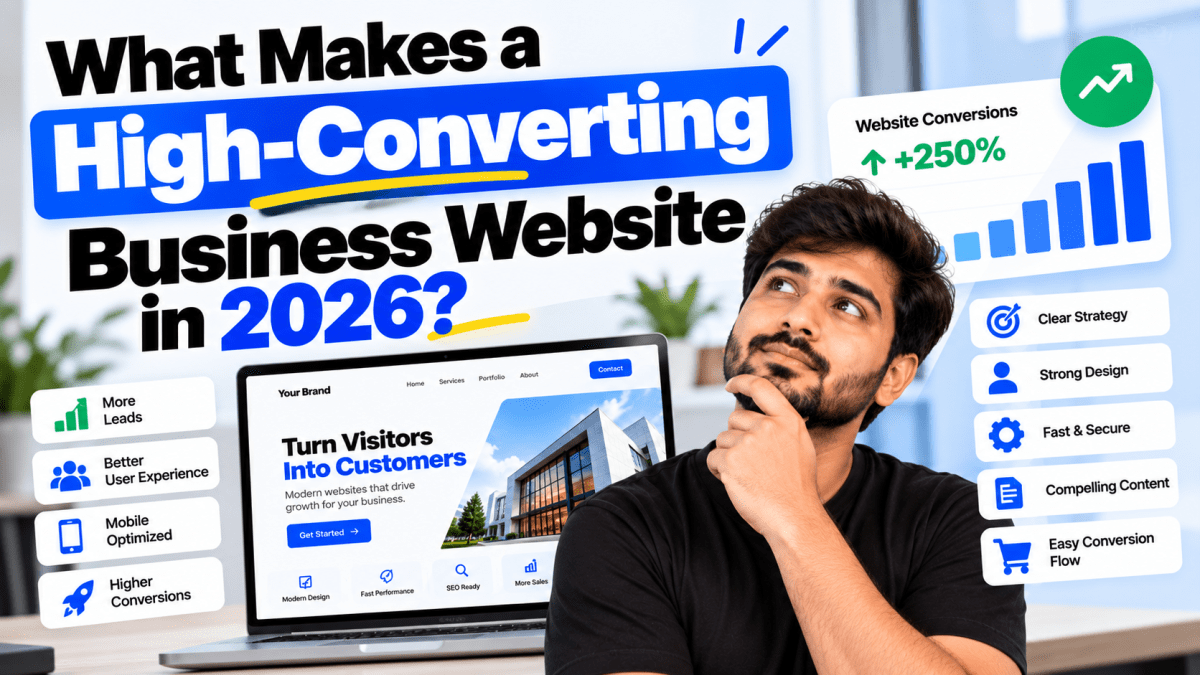
What Makes a High-Converting Business Website in 2026?#
Having a website is no longer enough.
In 2026, almost every serious business has some form of online presence. The real competitive advantage comes from what your website actually does once a potential customer lands on it.
Does it build trust?
Does it explain your offer clearly?
Does it load quickly?
Does it work properly on mobile?
Does it answer the customer's questions?
Does it make contacting your business easy?
Does it turn visitors into leads or customers?
If the answer to these questions is no, simply increasing your website traffic may not solve the problem.
You could send thousands of visitors to your website and still generate very few enquiries.
That is why conversion optimization matters.
A high-converting business website is designed around one fundamental objective:
Turn the right visitors into meaningful business actions.
That action could be:
- Calling your business
- Sending a WhatsApp message
- Filling out a lead form
- Booking an appointment
- Requesting a quotation
- Starting a free trial
- Purchasing a product
- Scheduling a consultation
- Signing up for a service
The exact conversion depends on your business.
This guide explains what makes a business website high-converting in 2026 and how you can build or redesign your website to generate better results.
What Is a High-Converting Website?#
A high-converting website is a website that effectively turns relevant visitors into desired actions.
For example, imagine two websites.
Website A#
Gets:
10,000 visitors/month
Generates:
50 leads
Conversion rate:
0.5%
Website B#
Gets:
5,000 visitors/month
Generates:
250 leads
Conversion rate:
5%
Website B receives half the traffic but generates five times as many leads.
This demonstrates an important point:
Traffic is not the same as business performance.
The goal should not always be to get more visitors.
The goal should be to get the right visitors and convert more of them.
What Is Website Conversion Rate?#
Conversion rate is the percentage of visitors who complete a desired action.
The basic formula is:
Conversion Rate = Conversions ÷ Visitors × 100
For example:
If 1,000 people visit your website and 30 submit a contact form:
30 ÷ 1,000 × 100 = 3%
Your conversion rate is 3%.
However, you should define the conversion based on your business.
For a service company, it might be:
- Lead form submission
- Phone call
- WhatsApp conversation
- Consultation booking
For an e-commerce company:
- Purchase
- Add to cart
- Checkout
For SaaS:
- Free trial
- Demo booking
- Account registration
There is no universal "good" conversion rate.
The right benchmark depends on:
- Industry
- Traffic source
- Offer
- Audience
- Price
- Customer intent
- Website quality
- Sales process
1. A Clear Value Proposition#
The first few seconds matter.
When someone lands on your website, they should quickly understand:
What do you offer?
Who is it for?
Why should they care?
A vague headline such as:
"Innovative Solutions for a Better Tomorrow"
sounds professional but tells the visitor almost nothing.
Compare that with:
"Custom Shopify Websites for Growing D2C Brands"
The second headline immediately communicates:
- Service
- Target audience
- Context
Clarity generally beats cleverness.
Your website should not make visitors work to understand what your business does.
2. A Strong Homepage Above the Fold#
The section visitors see before scrolling is commonly called the "above-the-fold" area.
It should establish the core message quickly.
A strong hero section can include:
Headline#
Clearly communicate your primary value proposition.
Supporting Text#
Explain the benefit in one or two sentences.
Primary CTA#
Tell visitors what to do.
Secondary CTA#
Give visitors another path if they aren't ready to convert.
Trust Signal#
Examples:
- Client count
- Years of experience
- Rating
- Certification
- Case study
- Industry expertise
For example:
Headline:
Build a Website That Generates Business
Supporting text:
Conversion-focused websites for startups and growing businesses.
CTA:
Get a Free Consultation
Secondary CTA:
View Our Work
The visitor immediately understands the offer and next steps.
3. One Primary Conversion Goal#
One of the biggest mistakes businesses make is giving visitors too many choices.
Imagine a homepage with:
- Contact Us
- Learn More
- Download
- Book Now
- Call Us
- Subscribe
- Request Demo
- View Portfolio
- Follow Instagram
- Join Newsletter
The visitor now has to decide what to do.
That's unnecessary friction.
Instead, establish a primary goal.
For a web development agency, the primary CTA might be:
Get a Website Quote
For a restaurant:
Reserve a Table
For a SaaS company:
Start Free Trial
For a consultant:
Book a Consultation
Secondary actions can exist, but the primary action should be obvious.
4. Strong and Specific Calls-to-Action#
"Submit" is technically a button.
It is not necessarily a compelling CTA.
Compare:
Submit
with:
Get My Free Website Audit
The second option communicates the outcome.
Other examples include:
- Get a Quote
- Book a Free Consultation
- Start Your Project
- Get a Demo
- Request Pricing
- Talk to an Expert
- Start Shopping
- Book an Appointment
Your CTA should tell the visitor what happens next.
5. Trust Is a Conversion Factor#
People don't buy from businesses they don't trust.
This becomes even more important when your website asks visitors to:
- Spend money
- Share personal information
- Book a service
- Upload documents
- Make a payment
- Start a long-term relationship
A trustworthy website can include:
- Customer testimonials
- Reviews
- Case studies
- Client logos
- Certifications
- Awards
- Team information
- Business address
- Phone number
- Email address
- Clear policies
- Secure payment indicators
Trust should not be fabricated.
Fake testimonials and fake statistics are not a conversion strategy.
They are a liability.
Trust should be demonstrated through evidence.
6. Real Testimonials#
A testimonial such as:
"Amazing service!"
is weak.
A better testimonial explains:
- Who the customer is
- What problem they had
- What was done
- What changed
For example:
"Stitchbyte redesigned our website and improved the mobile experience while simplifying our lead-generation process."
Specificity makes testimonials more credible.
Where appropriate, include:
- Customer name
- Company
- Role
- Photo
- LinkedIn profile
- Business website
Real evidence beats generic praise.
7. Case Studies#
Case studies are especially powerful for B2B businesses and professional services.
A strong case study can explain:
The Problem#
What was wrong?
The Objective#
What did the customer want?
The Solution#
What did you implement?
The Result#
What changed?
For example:
Before:
Outdated website with poor mobile experience.
Solution:
Redesigned responsive website with improved service architecture and lead forms.
Result:
Improved usability and a clearer conversion journey.
Case studies help potential customers visualize what working with your company might look like.
8. Professional Website Design#
Your website needs to look credible.
That does not mean it needs unnecessary animations or expensive visual effects.
Professional design usually means:
- Clear hierarchy
- Consistent typography
- Strong spacing
- Good contrast
- Quality imagery
- Consistent branding
- Intuitive navigation
- Clear CTAs
- Responsive layouts
The purpose of design is not to impress other designers.
The purpose is to help users understand and act.
9. Mobile-First Experience#
Your website must work properly on mobile devices.
Check:
- Navigation
- Buttons
- Forms
- Typography
- Images
- Videos
- Product pages
- Checkout
- Phone links
Google's guidance explicitly includes good mobile presentation as part of providing a good overall page experience.
Don't design the desktop version first and treat mobile as an afterthought.
For many businesses, mobile should be considered from the beginning.
10. Fast Website Performance#
Nobody likes waiting for a website.
Slow websites can create friction before the visitor even sees your offer.
Performance problems can come from:
- Huge images
- Unoptimized videos
- Excessive JavaScript
- Too many plugins
- Poor hosting
- Third-party scripts
- Poor caching
- Inefficient code
Google recommends paying attention to Core Web Vitals as part of overall page experience. However, Google also makes clear that good Core Web Vitals alone do not guarantee top rankings.
That distinction matters.
Don't optimize for a perfect score just because a tool gives you a number.
Optimize for the actual user experience.
11. Customer-Focused Copywriting#
Your website copy should focus on the customer.
Weak copy:
"We are a leading company providing innovative digital solutions."
Better copy:
"We build fast, conversion-focused websites that help small businesses generate more enquiries."
The second statement answers the customer's question:
"What's in it for me?"
Your website should communicate:
- Problems
- Benefits
- Outcomes
- Features
- Proof
- Process
- Objections
- Next steps
12. Explain Benefits, Not Just Features#
A feature tells the customer what something does.
A benefit explains why it matters.
Feature:#
Mobile responsive website.
Benefit:#
Give customers a smooth experience whether they visit from a phone, tablet, or desktop.
Feature:#
WhatsApp integration.
Benefit:#
Let potential customers start a conversation instantly without filling out a long form.
Feature:#
Payment gateway.
Benefit:#
Allow customers to complete purchases securely online.
The best websites connect features to business outcomes.
13. Simple Navigation#
Your website should make information easy to find.
Visitors should not have to hunt through five menus to discover your services.
A typical structure might be:
Home
Services
Portfolio
About
Blog
Contact
Depending on the business, you may also have:
- Pricing
- Industries
- Locations
- Resources
- Products
- Case Studies
Keep navigation focused.
More navigation options do not automatically create a better experience.
14. Landing Pages for Specific Audiences#
Your homepage cannot effectively speak to every audience.
Suppose a web development agency serves:
- Restaurants
- Healthcare
- Real estate
- E-commerce
- SaaS startups
Instead of sending everyone to one generic page, create focused landing pages.
For example:
Website Development for Restaurants
Website Development for Real Estate Companies
Shopify Development for D2C Brands
Each page can address:
- Industry-specific problems
- Relevant features
- Examples
- Case studies
- FAQs
- CTA
This creates a more relevant customer experience.
15. Strong Service Pages#
A service page should do more than say:
"We provide web development services."
It should answer:
What is the service?#
Who is it for?#
What does it include?#
How does the process work?#
How much does it cost?#
Why choose your company?#
What results can customers expect?#
What questions do customers have?#
What should they do next?#
Detailed service pages can also create opportunities for organic search traffic.
16. Remove Unnecessary Friction From Forms#
Your contact form should ask for information you genuinely need.
Bad form:
- Name
- Phone
- Company
- Address
- Industry
- Employee count
- Budget
- Revenue
- Website
- 15-question survey
For a simple enquiry, this may be excessive.
A shorter form could be:
- Name
- Email/Phone
- Requirement
Then qualify the lead later.
However, longer forms can make sense for high-value B2B leads where additional information genuinely improves qualification.
The correct form length depends on the business model.
17. Make Contacting You Extremely Easy#
Don't force customers to search for your phone number.
Depending on your audience, make important contact channels visible:
- Phone
- Contact form
- Booking system
For businesses in India, WhatsApp can be particularly useful as a low-friction communication channel.
A website visitor should be able to move from:
"I am interested"
to:
"I'm talking to the business"
with minimal effort.
18. Use Social Proof at the Right Time#
Don't put every testimonial in one giant section.
Place social proof near important decision points.
For example:
After Services#
Show relevant testimonials.
Before Pricing#
Show customer results.
Near CTA#
Show a short trust statement.
On Product Pages#
Show product reviews.
The principle is:
Reduce doubt at the moment the visitor is making a decision.
Trust is particularly important for e-commerce because users are deciding whether to spend money and share personal information. Research from Nielsen Norman Group emphasizes the role of credibility and trust in e-commerce decisions.
19. Make Pricing Easy to Understand#
Hiding all pricing isn't always a good strategy.
For some businesses, transparent pricing can improve lead quality.
For example:
Website Development — Starting at ₹30,000
This immediately filters out people with unrealistic budgets.
For custom projects, you can explain:
Custom projects are priced based on scope, functionality, integrations, and design requirements.
You don't necessarily need to publish every price.
But avoid creating unnecessary mystery.
20. Answer Customer Objections#
Your website should address the questions preventing visitors from converting.
Common objections include:
- How much does it cost?
- How long does it take?
- Is there a warranty?
- Do you provide support?
- Can I make changes later?
- Do I own the website?
- Do you provide SEO?
- Can you integrate WhatsApp?
- Can you integrate payments?
- What happens after launch?
A strong FAQ section can reduce friction.
21. Show the Process#
People feel more comfortable buying when they understand what happens next.
For example:
Step 1#
Discovery Call
Step 2#
Requirements & Strategy
Step 3#
UI/UX Design
Step 4#
Development
Step 5#
Testing
Step 6#
Launch
Step 7#
Support & Optimization
This turns an abstract service into a visible process.
22. Build for Search Engines and Humans#
SEO and conversion optimization should not be treated as enemies.
Your website should be easy for search engines to understand and useful for humans.
Google's current guidance emphasizes people-first content rather than content created primarily to manipulate rankings.
Important fundamentals include:
- Descriptive page titles
- Clear headings
- Useful content
- Internal links
- Search-friendly URLs
- Structured data where appropriate
- Good mobile experience
- Fast performance
- Crawlable pages
Google also supports structured data for various search features, including products, local businesses, articles, and other content types.
23. Create Content That Helps Customers Make Decisions#
Your blog should not exist simply because someone told you:
"Every company needs a blog."
Create content that helps potential customers move toward a decision.
For a web development company, useful topics could include:
- Website development costs
- WordPress vs Shopify
- Website redesign
- SEO
- E-commerce development
- Website conversion optimization
- AI automation
- Business software
Google specifically recommends creating helpful, reliable, people-first content rather than mass-producing pages purely to capture search traffic.
That means 50 useful articles are better than 500 thin articles that say essentially the same thing.
24. Use Visual Content Strategically#
Images should support the message.
Good visual content can include:
- Product images
- Before/after designs
- Screenshots
- Case studies
- Diagrams
- Process graphics
- Videos
- Demonstrations
Don't fill the website with generic stock photography that has nothing to do with the business.
Real visuals can strengthen credibility.
25. Make Search Intent Match the Landing Page#
Suppose someone searches:
"Shopify development company in India"
They should not land on a generic homepage that says:
"Welcome to our digital agency."
They should ideally land on a relevant page explaining:
- Shopify services
- Relevant experience
- Features
- Process
- Pricing guidance
- Case studies
- FAQs
- CTA
The closer the page matches the visitor's intent, the less work the visitor has to do.
26. Use Analytics and Conversion Tracking#
You cannot properly optimize a website if you don't know what users are doing.
Track meaningful actions such as:
- Form submissions
- Phone clicks
- WhatsApp clicks
- Purchases
- Bookings
- Downloads
- CTA clicks
- Signups
Then ask:
Where are users dropping off?
For example:
10,000 visitors
↓
2,000 visit service pages
↓
500 visit pricing
↓
100 start the form
↓
20 submit
The problem might be the form.
Or perhaps pricing creates friction.
Without tracking, you're guessing.
27. Use A/B Testing Where It Makes Sense#
Don't assume your first version is perfect.
Test meaningful variables such as:
- Headline
- CTA
- Form length
- Pricing presentation
- Page structure
- Offer
- Social proof
- Images
For example:
Version A#
Get a Website Quote
Version B#
Get Your Free Website Consultation
If version B produces more qualified leads over a statistically meaningful period, you have evidence rather than opinion.
Not every business needs sophisticated experimentation infrastructure.
But important conversion assumptions should eventually be tested.
28. Don't Overdesign the Website#
This deserves emphasis.
A high-converting website is not necessarily:
- Full of animations
- Extremely colorful
- Covered in gradients
- Packed with video
- Filled with interactive effects
Every design element should have a purpose.
If an animation makes the page slower but doesn't improve understanding or conversion, remove it.
If a video explains a complicated product better than text, use it.
Design should support the business objective.
29. Create a Strong Footer#
The footer is often ignored.
It can provide:
- Contact information
- Important pages
- Services
- Locations
- Social profiles
- Policies
- Business information
It can also reinforce trust.
For local businesses, including accurate business information is particularly useful.
30. Make Your Website Accessible#
A good website should be usable by as many people as reasonably possible.
Consider:
- Readable typography
- Sufficient contrast
- Keyboard navigation
- Descriptive labels
- Accessible forms
- Alternative text
- Logical heading structure
- Clear focus states
Accessibility is not merely a technical checkbox.
It improves usability for many users.
31. Security Should Be Built In#
Conversion requires trust.
Visitors are less likely to submit information or make payments if your website looks insecure.
Basic security measures include:
- HTTPS
- Secure hosting
- Updated dependencies
- Strong authentication
- Backups
- Secure forms
- Access controls
- Monitoring
If you're collecting sensitive customer data, security requirements become even more important.
32. Make Your Website Consistent With Your Brand#
Imagine seeing a premium brand on Instagram and then clicking its website only to find an outdated design.
The mismatch creates doubt.
Your website should align with:
- Logo
- Colors
- Typography
- Photography
- Tone of voice
- Brand positioning
Consistency strengthens recognition and credibility.
33. Personalize Where It Actually Helps#
Personalization can improve relevance.
For example:
A visitor from Mumbai could see:
Website Development Services for Mumbai Businesses
A returning customer could see:
Welcome Back
An e-commerce visitor could receive relevant recommendations.
But personalization should be useful rather than creepy.
Don't collect data simply because you can.
34. Build a Clear Customer Journey#
A high-converting website should guide users through a logical sequence.
For example:
Problem
↓
Solution
↓
Benefits
↓
Proof
↓
Offer
↓
CTA
↓
Conversion
The exact journey varies by business.
But the visitor should never feel like:
"Okay... what am I supposed to do now?"
35. Follow Up After the Conversion#
Conversion does not necessarily end when someone submits a form.
The next steps matter.
For example:
Website Form
↓
Instant Confirmation
↓
CRM
↓
Sales Notification
↓
WhatsApp/Email Follow-Up
↓
Sales Call
↓
Proposal
↓
Deal
This is where website development and business automation can work together.
A great website connected to a terrible sales process can still produce disappointing results.
36. Your Website Should Be Built for the Entire Funnel#
Think beyond the website.
Your customer journey might look like:
Google Search
↓
SEO Landing Page
↓
Service Page
↓
Case Study
↓
CTA
↓
Lead Form
↓
CRM
↓
Sales Team
The website is one component of the larger revenue system.
This is why web development, SEO, performance marketing, CRM, and automation increasingly need to work together.
37. Measure Business Results, Not Vanity Metrics#
Don't obsess over:
- Page views
- Time on page
- Followers
- Raw traffic
unless they connect to business outcomes.
Track:
- Qualified leads
- Conversion rate
- Cost per lead
- Sales
- Revenue
- Average order value
- Customer acquisition cost
- Return on ad spend
A website generating 100,000 visitors and zero customers is not necessarily successful.
A website generating 2,000 highly qualified visitors and ₹10 lakh in revenue may be dramatically more valuable.
38. Keep Improving After Launch#
Launching a website is not the finish line.
It's the beginning of optimization.
After launch:
- 1Collect data.
- 2Identify bottlenecks.
- 3Improve pages.
- 4Test CTAs.
- 5Improve speed.
- 6Update content.
- 7Add relevant landing pages.
- 8Improve SEO.
- 9Fix technical issues.
- 10Repeat.
This creates a continuous optimization cycle.
A High-Converting Website Checklist#
Before launching your website, ask:
Strategy#
- [ ] Is the target audience clearly defined?
- [ ] Is the primary business goal clear?
- [ ] Is the value proposition specific?
Design#
- [ ] Does the website look professional?
- [ ] Is the visual hierarchy clear?
- [ ] Is branding consistent?
- [ ] Are CTAs visible?
UX#
- [ ] Is navigation simple?
- [ ] Can users find important information quickly?
- [ ] Are forms easy to complete?
Mobile#
- [ ] Does it work properly on smartphones?
- [ ] Are buttons easy to tap?
- [ ] Does mobile navigation work?
Performance#
- [ ] Are images optimized?
- [ ] Is unnecessary JavaScript removed?
- [ ] Is the website tested on real devices?
- [ ] Are Core Web Vitals being monitored?
Google recommends considering Core Web Vitals alongside other aspects of overall page experience rather than treating them as the only measure of a good website.
Trust#
- [ ] Testimonials
- [ ] Reviews
- [ ] Case studies
- [ ] Business information
- [ ] Secure HTTPS
SEO#
- [ ] Page titles
- [ ] Meta descriptions
- [ ] Headings
- [ ] Internal links
- [ ] Sitemap
- [ ] Structured data where relevant
- [ ] Search Console
Conversion#
- [ ] Clear CTA
- [ ] Short/simple forms
- [ ] Phone
- [ ] Booking
- [ ] Relevant landing pages
Analytics#
- [ ] Traffic tracking
- [ ] Conversion tracking
- [ ] Form tracking
- [ ] Phone/WhatsApp click tracking
- [ ] E-commerce tracking where applicable
What Makes a Website High-Converting in 2026?#
If we simplify everything above, a high-converting business website has these characteristics:
1. It is clear.#
Visitors understand the offer immediately.
2. It is relevant.#
The content matches customer intent.
3. It is trustworthy.#
The business provides evidence rather than empty claims.
4. It is fast.#
Visitors don't have to wait unnecessarily.
5. It works on mobile.#
The experience is consistent across devices.
6. It is easy to navigate.#
Users can find information quickly.
7. It has strong CTAs.#
Visitors know what to do next.
8. It removes friction.#
Forms, checkout, booking, and communication are straightforward.
9. It is measurable.#
You know which actions produce business results.
10. It continuously improves.#
The website evolves based on actual data.
How Stitchbyte Builds Conversion-Focused Websites#
At Stitchbyte, we don't believe that a website should simply look good.
It should have a job.
That job might be:
- Generate leads
- Sell products
- Book appointments
- Build trust
- Increase organic traffic
- Automate enquiries
- Support sales
- Establish a professional digital presence
Depending on the business, we can work across:
- Business websites
- WordPress
- Shopify
- E-commerce
- Custom web development
- Landing pages
- UI/UX design
- SEO
- Performance optimization
- AI integrations
- Business automation
Our approach starts with the business objective.
For example, if your primary goal is lead generation, we focus on:
Positioning → Landing Pages → CTA → Form → CRM → Follow-Up
If your goal is e-commerce:
Product Discovery → Product Page → Trust → Cart → Checkout → Purchase
If your goal is local business growth:
Local Search → Website → Reviews → Contact → Booking
The architecture should follow the business model.
Final Thoughts#
A high-converting website is not created by adding more features.
It is created by removing friction between customer intent and business action.
Your visitor should be able to answer five questions quickly:
What do you offer?
Is it relevant to me?
Why should I trust you?
What will I get?
What should I do next?
If your website answers those questions clearly, provides a strong user experience, loads efficiently, works on mobile, demonstrates credibility, and measures meaningful conversions, you have the foundation of a high-performing digital asset.
And remember:
More traffic is not always the answer.
Sometimes the smarter strategy is to make the traffic you already have convert better.
A website that turns 1,000 relevant visitors into 50 qualified leads can be far more valuable than a website that attracts 10,000 visitors and converts almost none.
That's the difference between a website that exists and a website that works.
Frequently Asked Questions#
What is a high-converting business website?#
A high-converting business website effectively turns relevant visitors into desired actions such as enquiries, calls, bookings, signups, or purchases.
What is a good website conversion rate?#
There is no universal number. Conversion rates vary by industry, offer, traffic source, price, audience, and customer intent. Compare your performance against your own historical data and relevant business benchmarks.
Does good website design increase conversions?#
It can, but attractive design alone does not guarantee conversions. Effective design should improve clarity, trust, usability, navigation, and the customer journey.
How can I increase my website conversion rate?#
Start by improving your value proposition, CTA, trust signals, page speed, mobile experience, forms, service pages, landing pages, and customer journey. Use analytics to identify the biggest bottlenecks before making major changes.
Does website speed affect conversions?#
Yes. Slow experiences create friction and can cause visitors to abandon pages. Performance should therefore be treated as both a user-experience and business consideration.
Does SEO help website conversions?#
SEO primarily helps attract relevant organic traffic, but the landing pages that receive that traffic also need to satisfy user intent and provide a clear path to conversion.
Should I put my phone number and WhatsApp on my website?#
For businesses that generate enquiries through calls or WhatsApp, making those channels easy to access can reduce friction and improve the customer journey.
How important are testimonials?#
Testimonials can reduce uncertainty and strengthen credibility, especially when they are specific, authentic, and relevant to the customer's decision.
Should I redesign my website if it isn't converting?#
Possibly—but don't assume a redesign is automatically the answer. First determine whether the problem is traffic quality, messaging, offer, UX, technical performance, trust, or the sales process.
Can a small business have a high-converting website?#
Absolutely. A small business does not need a massive website. It needs a focused website with clear positioning, strong trust signals, useful content, simple navigation, and a frictionless conversion path.
Ready to Build a Website That Actually Converts?#
If your current website gets traffic but generates very few enquiries, or if you're planning a new website and want it built around business results from day one, the first step is to define the conversion goal.
Don't start with:
"What design should we use?"
Start with:
"What action do we want the customer to take?"
Then build the website around that objective.
Stitchbyte helps businesses design and develop websites focused on performance, user experience, SEO, lead generation, e-commerce, and business growth.
Your website shouldn't just be your online address.
It should be one of your best-performing business assets.
Planning a Custom Website or Web App in 2026?
Avoid agency markups and hidden renewal fees. Speak with our lead architects for a transparent, itemized scope and architectural proposal tailored to your business goals.
Related Topics & Tags
Enjoyed this article?
Share it with your teammates or network.
StitchByte Team
AuthorPublished by the StitchByte engineering & design team. We build high-performance web applications, AI automation agents, and modern digital platforms for scaling businesses across India and globally.