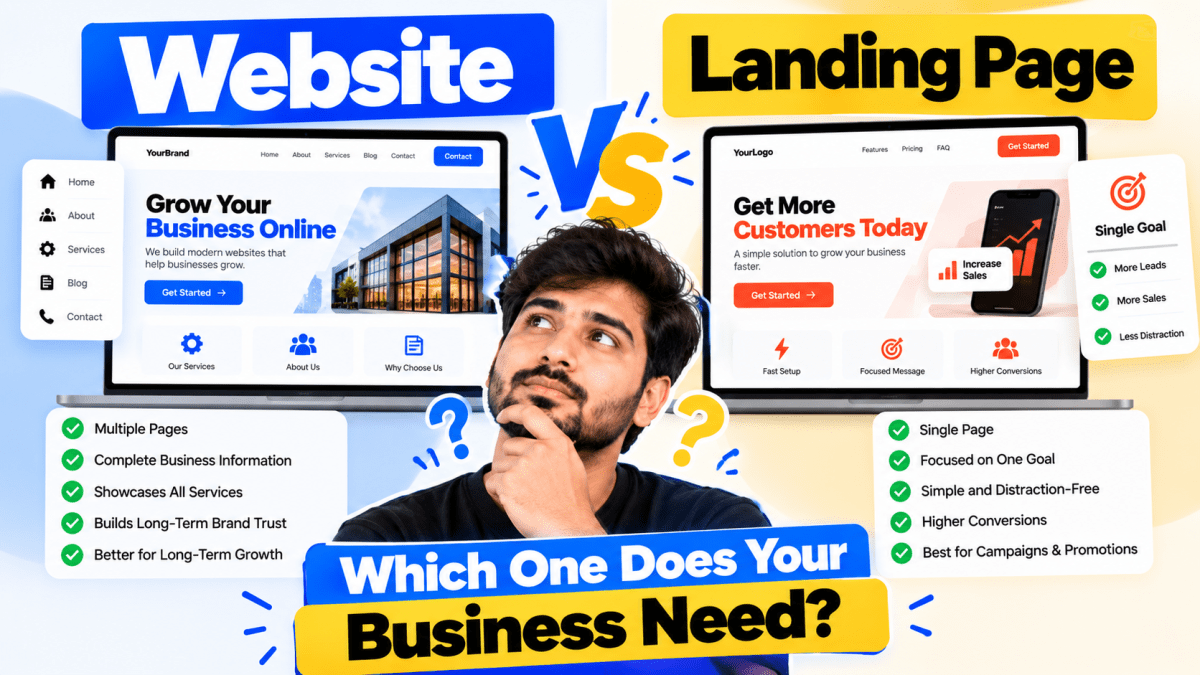
Website vs Landing Page: Which One Does Your Business Need?#
If you're planning to grow your business online, you may have come across two terms repeatedly:
Website
and
Landing page
They are often used interchangeably, but they are not the same thing.
A business website and a landing page serve different purposes.
A website is usually designed to establish your overall online presence, explain your business, showcase products or services, build trust, support SEO, and provide multiple paths for visitors.
A landing page is usually designed around a specific campaign, audience, offer, or conversion goal.
For example:
Website:
"Learn everything about our company and services."
Landing page:
"Get a free website audit."
Both can be extremely valuable.
The real question is:
Which one does your business need right now?
In many cases, the answer is actually:
Both.
This guide explains the differences between websites and landing pages, when you should use each, how much they can cost, and how businesses can use them together to generate more leads and sales.
What Is a Business Website?#
A business website is a collection of interconnected pages that represents your company online.
It can contain:
- Homepage
- About page
- Services
- Products
- Portfolio
- Case studies
- Blog
- Contact page
- FAQs
- Pricing
- Locations
- Testimonials
The website provides visitors with multiple ways to learn about the business.
Its objective is usually broader than a single conversion.
A business website can support:
- Branding
- SEO
- Lead generation
- Customer education
- Product discovery
- E-commerce
- Recruitment
- Customer support
- Business credibility
Think of your website as your digital headquarters.
What Is a Landing Page?#
A landing page is a focused web page designed around a specific goal.
For example:
Get a Free 30-Minute Business Consultation
The entire page can be built around convincing the visitor to take that one action.
A landing page may include:
- Headline
- Offer
- Benefits
- Features
- Social proof
- Testimonials
- FAQs
- Objection handling
- CTA
- Lead form
It generally has fewer distractions than a typical website page.
For example, a paid advertising campaign might send users directly to:
Facebook Ad → Landing Page → Lead Form → Sales Team
rather than:
Facebook Ad → Homepage → Services → About → Contact
The first journey can be much more focused.
Website vs Landing Page: Quick Comparison#
| Feature | Business Website | Landing Page |
|---|---|---|
| Main purpose | Overall online presence | Specific conversion |
| Number of pages | Multiple | Usually one focused page |
| Navigation | Usually available | Often limited |
| SEO | Strong long-term potential | Depends on strategy |
| Branding | Comprehensive | Campaign-focused |
| Content | Broad | Highly focused |
| Traffic sources | Search, social, direct, referrals | Often ads, campaigns, email, social |
| Conversion goal | Multiple | Usually one primary goal |
| Best for | Long-term presence | Campaigns and lead generation |
| Updates | Ongoing | Campaign-specific |
Neither option is universally better.
They solve different problems.
Website vs Landing Page: The Biggest Difference#
The biggest difference is focus.
A website answers:
"Who is this business and what does it offer?"
A landing page answers:
"Why should I take this specific action right now?"
That's a major distinction.
A website may have:
- 10 services
- 5 industries
- 20 blog articles
- About page
- Careers
- Portfolio
- Contact
A landing page might focus entirely on:
Book a Free SEO Audit
Everything on that page supports the same objective.
When Should Your Business Build a Website?#
A full website is usually the better choice when you need a long-term digital presence.
Consider building a website if:
You Want to Build Brand Credibility#
Customers often research a company before buying.
A professional website gives them a place to learn about:
- Your company
- Your services
- Your team
- Your work
- Your customers
- Your expertise
You Want to Rank on Google#
A website provides more opportunities to target different search queries.
For example, a web development agency could create pages for:
- Website Development
- Shopify Development
- WordPress Development
- E-commerce Development
- Custom Software
- SEO
- AI Automation
It can also publish helpful content around related topics.
This creates a broader SEO footprint than a single landing page.
You Offer Multiple Services#
Suppose your business provides:
- Web development
- SEO
- Digital marketing
- Branding
- AI automation
Trying to explain all of these services on one landing page can make the page unnecessarily long and confusing.
A website allows you to create dedicated pages for each service.
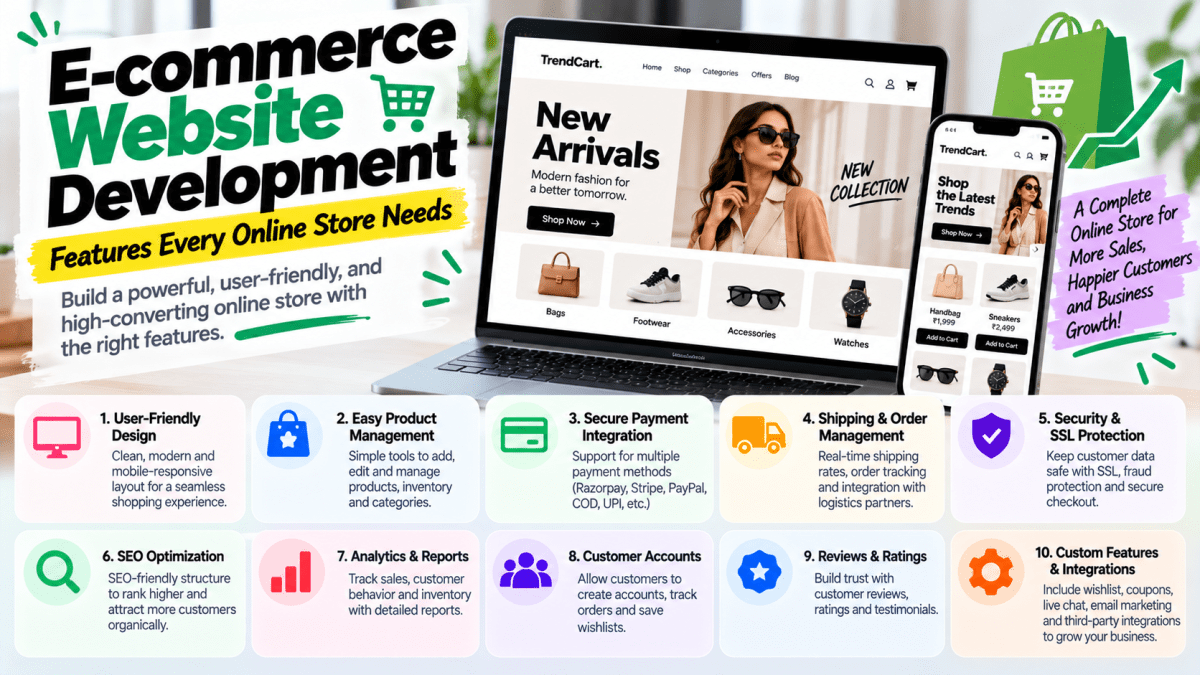
You Need E-commerce#
If you're selling multiple products, a full e-commerce website or store is generally more appropriate.
You may need:
- Product pages
- Categories
- Search
- Filters
- Cart
- Checkout
- Customer accounts
- Payment gateway
- Shipping
- Reviews
- Order tracking
A single landing page isn't a replacement for a complete e-commerce system.
You Want Long-Term Organic Traffic#
SEO generally works best when you build a useful, structured collection of content and pages.
A website can support:
- Service pages
- Location pages
- Blog content
- Product pages
- FAQs
- Case studies
This creates more opportunities to match different search intents.
However, simply creating hundreds of pages does not guarantee rankings.
The content needs to be genuinely useful and relevant.
You Need Multiple Customer Journeys#
Different visitors may have different goals.
One person may want:
Pricing
Another:
Portfolio
Another:
About the company
Another:
Contact information
A website can accommodate all of these paths.
When Should Your Business Use a Landing Page?#
Landing pages are particularly useful when you have a specific marketing objective.
For example:
Paid Advertising#
Meta Ad → Landing Page → Lead
Google Ads#
Search Ad → Service Landing Page → Enquiry
Email Marketing#
Email → Offer Page → Purchase
Social Media#
Instagram → Campaign Page → Booking
Product Launch#
Announcement → Landing Page → Registration
The more specific the campaign, the more useful a dedicated landing page can become.
Landing Pages Are Excellent for Paid Ads#
Suppose you run a Meta Ads campaign promoting website development.
Your advertisement says:
Get a Professional Business Website Starting at ₹30,000
If you send the user to your generic homepage, they may have to search for:
- Website development
- Pricing
- Portfolio
- Contact information
Instead, send them to a page specifically built around the offer.
The page can include:
Headline#
Professional Business Websites Starting at ₹30,000
Benefits#
- Mobile responsive
- SEO-ready
- WhatsApp integration
- Professional design
- Fast delivery
Proof#
Client projects and testimonials.
CTA#
Get Your Website Quote
The entire experience is aligned with the advertisement.
Why Message Match Matters#
One of the most important landing-page principles is message match.
The advertisement and landing page should communicate the same core offer.
For example:
Ad#
Shopify Store Development Starting at ₹35,000
Landing Page#
Shopify Store Development for Growing Businesses
That's a logical transition.
But if the ad says:
Shopify Store Development
and the landing page says:
Welcome to Our Digital Agency
the visitor may wonder whether they are even in the right place.
Consistency reduces friction.
Landing Page vs Homepage#
This is another important distinction.
Your homepage usually needs to serve multiple audiences.
A landing page can serve one specific audience.
For example:
Homepage#
Stitchbyte — Web Development, SEO, Digital Marketing & AI Automation
Landing Page#
Shopify Website Development for Indian D2C Brands
The landing page is much more specific.
That specificity can be useful for paid campaigns and targeted marketing.
Why Sending Every Ad to Your Homepage Can Be a Mistake#
Imagine someone clicks an ad for:
"Website Development for Restaurants."
They land on a homepage containing:
- Web development
- SEO
- AI
- Shopify
- Digital marketing
- Branding
- About
- Careers
- Blog
The visitor now has to find the information relevant to restaurants.
That creates unnecessary friction.
A dedicated page could instead say:
Restaurant Website Development
Then explain:
- Online menu
- Table booking
- Online ordering
- Google Maps
- Food photography
- Local SEO
That's a much more relevant experience.
Can a Landing Page Rank on Google?#
Yes.
A landing page can potentially rank organically if it is genuinely useful, technically accessible, relevant to search intent, and supported by appropriate site architecture and authority.
But don't assume every landing page should be built primarily for SEO.
Some landing pages exist specifically for paid campaigns.
For example:
Google Ads → Landing Page
The page may intentionally have minimal navigation because the objective is conversion rather than broad website exploration.
The strategy should depend on the traffic source and objective.
Website vs Landing Page for SEO#
A website generally has more SEO opportunities because it can contain many relevant pages.
For example:
Homepage
↓
Web Development
↓
Shopify Development
↓
Shopify Development for Fashion Brands
↓
Shopify Pricing Guide
↓
Shopify SEO Guide
This creates a broader content ecosystem.
A single landing page is much more limited.
However, a highly relevant landing page can still perform extremely well for a targeted keyword.
Website vs Landing Page for Lead Generation#
For pure lead generation, a landing page can often be more focused.
For example:
Traffic
↓
Offer
↓
Benefits
↓
Proof
↓
FAQ
↓
CTA
A general website may have many more paths.
That isn't necessarily bad.
But when running a specific campaign, excessive navigation can create distractions.
Website vs Landing Page for Branding#
A full website generally wins for broader brand building.
You can showcase:
- Brand story
- Team
- Portfolio
- Products
- Services
- Reviews
- Case studies
- Content
A landing page can still be beautifully branded, but it usually has a narrower purpose.
Website vs Landing Page for E-commerce#
For an e-commerce business, a complete store is usually necessary.
However, landing pages can still be valuable.
For example:
Instagram Ad → New Collection Landing Page → Product Pages
Or:
Google Ads → Best-Selling Product Landing Page → Checkout
The landing page becomes part of the sales funnel rather than replacing the store.
Website vs Landing Page for Local Businesses#
Local businesses often need both.
For example, a dental clinic may have a website containing:
- Home
- About
- Treatments
- Doctors
- Testimonials
- Locations
- Contact
But it may also create a landing page specifically for:
Dental Implant Consultation in Jaipur
That page can be used for:
- Google Ads
- Meta Ads
- Local campaigns
- Promotional offers
The website builds overall credibility.
The landing page supports the specific campaign.
Website vs Landing Page for Startups#
Startups should think carefully about their stage.
A very early startup may need a simple landing page to validate demand.
For example:
AI-powered CRM for Small Businesses
The landing page can collect:
- Email addresses
- Demo requests
- Early-access registrations
If the product gains traction, the company can expand into a complete website.
This can be more efficient than spending months building a large website before validating the idea.
Website vs Landing Page for Small Businesses#
For most established small businesses, a website is the better foundation.
For example:
A local marketing agency might need:
- Home
- About
- Services
- Portfolio
- Testimonials
- Blog
- Contact
Then it can add landing pages for campaigns such as:
Get 20 Qualified Leads Per Month
The website becomes the foundation.
Landing pages become campaign assets.
Can You Have a Website Without Landing Pages?#
Absolutely.
But if you run paid advertising, dedicated landing pages can improve the relevance of your campaigns.
A business spending ₹1,00,000 per month on advertising but sending every click to the homepage may be leaving optimization opportunities on the table.
The right landing page can align:
Ad → Message → Offer → Audience → CTA
Can You Have a Landing Page Without a Website?#
Yes.
This is particularly useful for:
- New businesses
- Product validation
- Event registration
- Lead-generation campaigns
- Temporary offers
- Pre-launch campaigns
- Startup MVPs
For example:
Launching a new SaaS product? Join the early-access list.
A single page may be enough initially.
But as the business grows, a full website may become necessary.
How Much Does a Landing Page Cost in India?#
The price depends on complexity.
A basic landing page might cost:
₹5,000–₹15,000
A professionally designed conversion-focused landing page might cost:
₹15,000–₹40,000+
A highly customized landing page with:
- Custom UI/UX
- Animations
- Advanced forms
- CRM integration
- Analytics
- A/B testing
- Payment integration
can cost significantly more.
The important factor is not the number of sections.
It is the amount of strategy, design, development, and functionality involved.
How Much Does a Business Website Cost in India?#
A basic business website may start around:
₹10,000–₹30,000
A professional business website may range around:
₹30,000–₹75,000+
A more advanced corporate or custom website can cost:
₹75,000–₹2,00,000+
E-commerce websites and custom web applications can cost substantially more.
The actual price depends on:
- Number of pages
- Design
- Technology
- Content
- Integrations
- SEO
- E-commerce
- Custom functionality
- Maintenance
What Should a Landing Page Include?#
A high-quality landing page generally includes:
1. Clear Headline#
Tell visitors what you're offering.
2. Supporting Statement#
Explain the primary benefit.
3. Strong CTA#
Tell users what to do.
4. Benefits#
Explain why the offer matters.
5. Features#
Explain what they receive.
6. Social Proof#
Show evidence.
7. Testimonials#
Reduce uncertainty.
8. Case Studies#
Demonstrate outcomes.
9. Objection Handling#
Answer common questions.
10. FAQ#
Remove final doubts.
11. Final CTA#
Give visitors another opportunity to convert.
What Should a Business Website Include?#
A professional business website may include:
- Homepage
- About
- Services
- Products
- Portfolio
- Case studies
- Testimonials
- Blog
- FAQ
- Contact
- Pricing
- Locations
The exact structure should be based on the business.
Don't create pages simply to make the website look larger.
Can a Website and Landing Page Work Together?#
Yes.
In fact, this is often the strongest approach.
Think of the website as the digital headquarters.
Think of landing pages as specialized conversion assets.
For example:
Organic Search#
Google → Service Page → Contact
Meta Ads#
Instagram → Landing Page → Lead Form
Google Ads#
Search → Campaign Landing Page → Consultation
Email#
Newsletter → Offer Landing Page → Purchase
Social Media#
Instagram → Product Page → Checkout
Each page has a specific role.
A Practical Funnel for Stitchbyte#
For a company like Stitchbyte, a lead-generation funnel could look like:
Meta Ad
↓
"Professional Business Website Starting at ₹30,000"
↓
Dedicated Website Development Landing Page
↓
Portfolio
↓
Benefits
↓
Testimonials
↓
Pricing
↓
FAQ
↓
Get a Quote
↓
Lead Form / WhatsApp
↓
Sales Follow-Up
Meanwhile, the main Stitchbyte website can handle:
- Brand discovery
- SEO
- Service exploration
- Portfolio
- Blog
- Company information
- Organic traffic
This is far more scalable than trying to make one homepage perform every job.
Common Mistakes Businesses Make#
Mistake 1: Thinking a Landing Page Is Just a Short Website#
A landing page is not defined by length.
It is defined by purpose.
A landing page can be very long if the offer requires extensive explanation.
Mistake 2: Sending Every Ad to the Homepage#
This can create message mismatch and unnecessary navigation.
Mistake 3: Creating a Landing Page With No Clear CTA#
If visitors don't know what to do, the page has failed at its primary job.
Mistake 4: Making the Landing Page Too Distracting#
If the goal is one conversion, don't add 15 unrelated links.
Mistake 5: Building a Huge Website Before Validating Demand#
Startups can waste significant resources building features nobody wants.
Sometimes a focused landing page is enough to test demand first.
Mistake 6: Treating SEO and Conversion as Separate Worlds#
Your SEO pages should still be useful and persuasive.
Traffic without conversion is not the end goal.
Mistake 7: Ignoring Mobile#
Whether it's a website or landing page, mobile usability matters.
How to Decide: Website or Landing Page?#
Use this simple framework.
Choose a Website If:#
- You are building a long-term brand
- You have multiple services
- You need organic search visibility
- Customers need detailed information
- You need multiple pages
- You sell many products
- You need a comprehensive online presence
Choose a Landing Page If:#
- You have one specific offer
- You are running an advertising campaign
- You want one primary conversion
- You're testing a business idea
- You are launching a product
- You are promoting an event
- You need a focused lead-generation page
Choose Both If:#
- You have an established business
- You run paid advertising
- You want SEO
- You need long-term brand building
- You want dedicated campaign funnels
For many growing businesses, both is the strongest option.
Website vs Landing Page Decision Table#
| Business Requirement | Website | Landing Page |
|---|---|---|
| Brand presence | Excellent | Good |
| Multiple services | Excellent | Limited |
| SEO | Excellent | Good |
| Paid advertising | Good | Excellent |
| Lead generation | Excellent | Excellent |
| Product launch | Good | Excellent |
| E-commerce | Excellent | Limited |
| Startup validation | Good | Excellent |
| Long-term content | Excellent | Limited |
| Single campaign | Good | Excellent |
| Multiple customer journeys | Excellent | Limited |
| Local business | Excellent | Excellent |
How to Use Landing Pages With Google Ads#
Suppose you are running Google Ads for:
"Shopify Development Company"
Instead of sending traffic to your homepage, create:
/shopify-development
The page should contain:
- Shopify services
- Shopify features
- Portfolio
- Benefits
- Pricing guidance
- FAQs
- Testimonials
- CTA
The visitor sees exactly what they searched for.
That alignment can improve the user experience and potentially improve campaign performance.
How to Use Landing Pages With Meta Ads#
Meta advertising works differently because users may not actively be searching for your service.
You have to create interest quickly.
For example:
Ad#
Need a Professional Website for Your Business?
Landing Page#
Launch a Professional Business Website Starting at ₹30,000.
Then show:
- Examples
- Benefits
- Process
- Pricing
- Testimonials
- CTA
The landing page continues the story started by the advertisement.
Landing Page vs Service Page#
These are also different.
A service page is generally part of your main website architecture.
Example:
/services/web-development
Its objectives can include:
- SEO
- Education
- Service discovery
- Conversion
A landing page may be created specifically for:
/website-development-offer
Its primary objective could be generating leads from a specific advertising campaign.
There can be overlap, but the intent is different.
Should Landing Pages Have Navigation?#
It depends.
For paid advertising campaigns, reducing unnecessary navigation can help keep visitors focused.
For SEO-focused landing pages, some navigation may be useful because users may need to explore related content.
There is no universal rule.
Ask:
Does this link help the visitor complete the intended action?
If not, it may be unnecessary.
The Ideal Strategy for Most Growing Businesses#
If your business is established, don't think:
Website OR landing page.
Think:
Website AND landing pages.
Your website handles:
- Brand
- SEO
- Trust
- Services
- Content
- Organic discovery
Landing pages handle:
- Campaigns
- Offers
- Paid traffic
- Specific audiences
- Specific conversions
Together, they create a stronger digital acquisition system.
How Stitchbyte Can Help#
At Stitchbyte, we can help businesses build both sides of the digital funnel.
Business Websites#
We develop websites for:
- Small businesses
- Startups
- Agencies
- Service companies
- E-commerce brands
- Local businesses
Landing Pages#
We can build campaign-focused pages for:
- Meta Ads
- Google Ads
- Product launches
- Lead generation
- Events
- Offers
- Service campaigns
Supporting Services#
Depending on the project, this can also include:
- UI/UX design
- SEO
- Conversion optimization
- Analytics
- WhatsApp integration
- CRM integration
- Payment gateways
- AI automation
The goal is not simply to build a page.
The goal is to create a customer acquisition system.
Final Verdict#
So, which one does your business need?
The answer depends on your objective.
If you need a long-term digital presence, multiple services, SEO, branding, and comprehensive customer information:
Build a website.
If you have a specific offer, campaign, advertisement, product launch, or lead-generation objective:
Build a landing page.
If you are an established business running marketing campaigns:
Build both.
The website is your digital headquarters.
The landing page is your focused conversion tool.
Neither replaces the other.
The smartest businesses use each one where it performs best.
Frequently Asked Questions#
Is a landing page the same as a website?#
No. A website usually contains multiple interconnected pages and serves broader business objectives. A landing page is typically focused on a specific audience, campaign, offer, or conversion goal.
Do I need a website if I have a landing page?#
Not necessarily. A startup testing an idea or running a specific campaign may be able to start with a landing page. However, an established business usually benefits from having a complete website as its long-term digital presence.
Can a landing page rank on Google?#
Yes. A landing page can rank if it is relevant, useful, technically accessible, and satisfies search intent. However, many landing pages are created primarily for paid advertising rather than organic search.
Are landing pages better for lead generation?#
They can be, particularly when the traffic comes from a specific campaign and the page has one clear objective. But conversion performance depends on the offer, audience, traffic quality, copy, design, and sales process.
Should I send Google Ads traffic to my homepage?#
Not always. A dedicated landing page that closely matches the advertisement and search intent can provide a more focused experience.
How much does a landing page cost in India?#
Basic landing pages can start around ₹5,000–₹15,000. Professionally designed conversion-focused landing pages can cost ₹15,000–₹40,000 or more depending on complexity and integrations.
How much does a business website cost in India?#
A basic business website may start around ₹10,000–₹30,000. Professional websites commonly range higher depending on design, pages, functionality, SEO, and integrations.
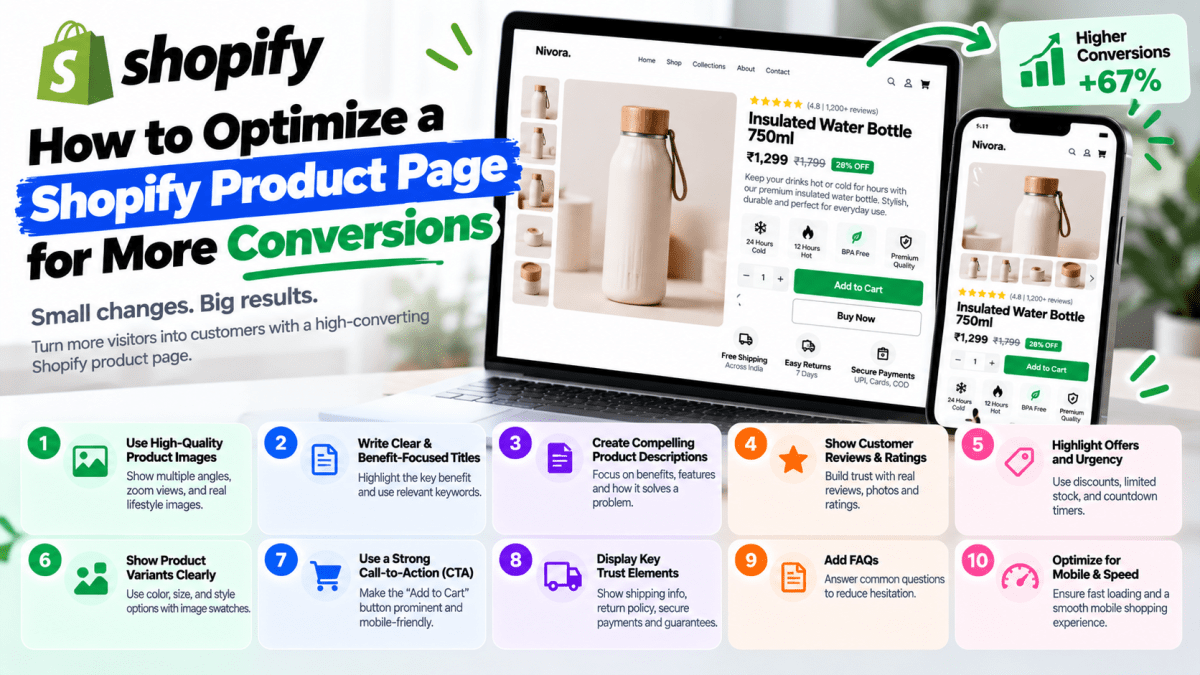
Can Shopify businesses use landing pages?#
Yes. Shopify stores can use campaign-specific landing pages to promote collections, products, offers, or advertising campaigns.
Can I use one landing page for all my ads?#
You can, but it isn't always optimal. Different campaigns may target different audiences, products, or search intents. Dedicated landing pages can provide better message alignment.
Should a landing page have a menu?#
It depends on the purpose. A paid campaign may benefit from reduced navigation, while an SEO-focused page may benefit from normal website navigation. The correct approach depends on the conversion goal.
Can I have multiple landing pages?#
Yes. In fact, multiple landing pages can be useful when you target different audiences, services, locations, offers, or campaigns.
Ready to Build the Right Digital Experience?#
Before deciding between a website and a landing page, define the business objective.
Ask:
Are we building a brand?
Are we generating leads?
Are we selling products?
Are we running paid advertising?
Are we testing a new offer?
Once the objective is clear, the right structure becomes much easier to determine.
Stitchbyte helps businesses build websites, landing pages, e-commerce stores, and digital experiences designed around real business objectives.
Don't build more pages simply because you can.
Build the right pages for the job.
Planning a Custom Website or Web App in 2026?
Avoid agency markups and hidden renewal fees. Speak with our lead architects for a transparent, itemized scope and architectural proposal tailored to your business goals.
Related Topics & Tags
Enjoyed this article?
Share it with your teammates or network.
StitchByte Team
AuthorPublished by the StitchByte engineering & design team. We build high-performance web applications, AI automation agents, and modern digital platforms for scaling businesses across India and globally.