How Professional Web Design Builds Trust and Increases Sales#
Your website is often the first serious interaction a potential customer has with your business.
Before they call you, visit your office, request a quotation, or purchase your product, they may first search for your business online.
And within a few seconds of landing on your website, they're already forming an opinion.
Does this business look legitimate?
Can I trust them?
Do they understand what they're doing?
Is this company professional?
Is their product or service worth paying for?
These questions are rarely asked consciously. Customers often make these judgments based on visual design, usability, content, speed, credibility signals, and how easy the website makes it to take action.
That's why professional web design is much more than choosing attractive colors and adding animations.
A well-designed website can communicate trust, credibility, quality, professionalism, and value before your sales team ever speaks with the customer.
And when trust increases, the chances of conversion can increase as well.
In this guide, we'll explore how professional web design builds trust, how design affects purchasing decisions, what makes a website look credible, common design mistakes that hurt sales, and how businesses can turn their websites into stronger conversion tools.
What Is Professional Web Design?#
Professional web design is the process of designing a website around the needs of both the business and its customers.
It includes much more than visual appearance.
Professional web design considers:
- User experience
- Visual hierarchy
- Branding
- Typography
- Color systems
- Navigation
- Mobile responsiveness
- Website speed
- Accessibility
- Content structure
- Calls-to-action
- Conversion paths
- SEO
- Trust signals
- Security
- Forms
- Product presentation
- Analytics
A professionally designed website should answer three questions quickly:
1. Who are you?#
The visitor should immediately understand the business.
2. What do you offer?#
Your products or services should be obvious.
3. Why should the customer choose you?#
Your website should communicate your value and credibility.
If visitors can't answer these questions easily, the website is creating unnecessary friction.
Why Does Website Design Affect Customer Trust?#
Imagine two businesses offering the same service.
Business A#
Its website has:
- Broken layouts
- Low-quality images
- Inconsistent fonts
- Slow pages
- Difficult navigation
- Outdated information
- No testimonials
- No clear contact details
Business B#
Its website has:
- Clean design
- Professional branding
- Clear service information
- Real photographs
- Testimonials
- Case studies
- Easy navigation
- Fast pages
- Mobile-friendly layouts
- Clear contact options
Even if both companies provide equally good services, many customers will naturally feel more comfortable with Business B.
Why?
Because people use visible signals to estimate invisible qualities.
A professional website doesn't prove that a company is excellent.
But it can create the perception that the company is organized, established, trustworthy, and serious about its work.
That's incredibly important during the buying process.
1. Your Website Creates the First Impression#
Your website is part of your brand.
When someone discovers your company through:
- YouTube
- An advertisement
- A referral
they may visit your website before taking the next step.
The website then becomes the digital equivalent of walking into your business.
Think about a physical store.
If the entrance is broken, the lighting is poor, products are difficult to find, and nothing is organized, customers may question the quality of the business.
Your website works similarly.
A clean, organized digital experience communicates professionalism.
2. Good Design Communicates Professionalism#
Professionalism isn't just about having a beautiful interface.
It's about consistency.
For example, your website should have a consistent:
- Logo
- Color palette
- Typography
- Button style
- Image treatment
- Spacing
- Tone of voice
- Iconography
- Layout structure
When everything looks intentional, visitors are more likely to perceive the business as organized.
In contrast, inconsistent design can make a company look inexperienced.
Example#
Imagine a website where:
- The homepage uses blue
- The service pages use orange
- Every section has a different font
- Buttons have different shapes
- Images have inconsistent quality
- Some pages look completely different
The problem isn't just aesthetic.
The website feels unreliable.
3. Visual Quality Influences Perceived Business Quality#
Customers frequently use visual presentation as a shortcut for evaluating businesses.
Consider luxury products.
A premium product usually comes with:
- Premium photography
- Carefully designed packaging
- High-quality typography
- Sophisticated presentation
- Consistent branding
The website should reinforce that perception.
If you're selling a ₹1 lakh product through a website that looks like it was built in five minutes, the customer may hesitate.
This creates a simple relationship:
Perceived quality → perceived value → willingness to buy
Professional design helps communicate value before the customer experiences the actual product or service.
4. A Clear Website Reduces Customer Confusion#
Confusion kills conversions.
If visitors don't understand:
- What you sell
- Who you serve
- What makes you different
- How much it costs
- How to contact you
- What they should do next
they may simply leave.
Professional web design uses visual hierarchy to guide visitors.
For example:
Primary headline#
What do you offer?
Supporting text#
Why does it matter?
Primary CTA#
What should the visitor do?
Proof#
Why should they trust you?
Benefits#
What do they get?
Final CTA#
What's the next step?
This creates a logical customer journey.
5. Strong Branding Builds Recognition#
Your website shouldn't look like a random template.
It should feel like your brand.
Strong web design connects the website with your overall identity across:
- Business cards
- Packaging
- Advertisements
- Presentations
- Physical locations
When the visual identity remains consistent, customers begin to recognize the business.
For example, a consistent brand system may include:
Logo + Colors + Typography + Photography + Voice + Layout
Together, these elements create a recognizable identity.
6. Mobile Design Builds Trust#
A website that looks excellent on desktop but breaks on mobile can damage credibility.
Imagine clicking a company's website from Instagram and finding:
- Tiny text
- Broken buttons
- Overlapping sections
- Horizontal scrolling
- Slow loading
- Difficult navigation
The customer doesn't think:
"This website probably has a CSS issue."
They think:
"This company doesn't seem very professional."
That's why professional web design must include a strong mobile experience.
Your website should work smoothly across:
- Smartphones
- Tablets
- Laptops
- Desktop monitors
Mobile-first design is particularly important because many customers discover businesses through mobile devices.
7. Website Speed Affects User Experience#
A website can have excellent design and still lose customers if it loads slowly.
Users expect websites to respond quickly.
Slow performance can create:
- Frustration
- Abandonment
- Lower engagement
- Poor user experience
- Reduced conversions
Professional web development therefore considers performance from the beginning.
This includes:
- Image optimization
- Efficient code
- Caching
- CDN usage where appropriate
- Reduced JavaScript
- Optimized fonts
- Efficient hosting
- Proper media handling
Design and performance should not be treated as separate problems.
A beautiful website that takes forever to load isn't a great website.
8. Professional Photography Builds Credibility#
Images communicate information faster than text.
But the wrong images can hurt credibility.
Weak approach#
Using random stock photos that don't represent your actual business.
For example, a local construction company using a generic photograph of a construction worker from a stock website.
Stronger approach#
Use:
- Real team photographs
- Real office images
- Real projects
- Real products
- Customer photos
- Before-and-after results
- Behind-the-scenes content
Real visuals provide evidence.
They help customers understand that there is an actual business behind the website.
9. Testimonials Reduce Buying Risk#
Customers naturally have concerns before buying.
They may think:
"Will this company actually deliver?"
Testimonials can help reduce that uncertainty.
A strong testimonial section can include:
- Customer name
- Photograph where appropriate
- Company name
- Specific result
- Customer experience
- Video testimonial where available
Compare:
"Great service!"
with:
"The new website increased qualified enquiries and made it much easier for customers to request quotations."
The second is more useful because it communicates a specific experience.
10. Case Studies Provide Evidence#
Testimonials tell customers what people say.
Case studies show what you've done.
A strong case study can include:
Client#
Who was the customer?
Problem#
What problem did they have?
Strategy#
What did you do?
Solution#
What did you build or implement?
Outcome#
What changed?
For a web development agency, a case study might show:
Before → Strategy → Website → Result
This is powerful because it turns your website from a collection of claims into evidence.
11. Trust Signals Make Businesses Feel Safer#
Professional websites often use multiple trust signals.
Examples include:
- Client logos
- Testimonials
- Reviews
- Certifications
- Awards
- Security information
- Business address
- Phone number
- Email address
- Company registration details where appropriate
- Privacy policy
- Terms and conditions
- Return/refund policies
- Case studies
- Industry memberships
The right trust signals depend on the business.
A healthcare website may need different credibility elements from an e-commerce website.
12. Transparent Information Builds Trust#
Customers don't like feeling manipulated.
A website that hides basic information can create suspicion.
Depending on your business model, consider clearly explaining:
- Services
- Pricing or starting prices
- Delivery timelines
- Process
- Policies
- Contact information
- Frequently asked questions
You don't necessarily need to publish every commercial detail.
But providing enough information to help customers make an informed decision can increase confidence.
13. A Professional Contact Page Matters#
Your contact page shouldn't be an afterthought.
A professional contact page may include:
- Phone number
- Address
- Google Maps location
- Business hours
- Contact form
- Social links
For local businesses, location information can be particularly important.
For service businesses, a clear enquiry process can make the difference between a visitor and a lead.
14. Clear Calls-to-Action Increase Conversion Opportunities#
Your website should tell visitors what to do next.
Examples:
Get a Quote
Book a Consultation
Schedule a Demo
Shop Now
Start Your Project
Request Pricing
Call Us
Chat on WhatsApp
Without a clear CTA, users may browse the website and leave without taking action.
A good CTA should be:
- Visible
- Specific
- Action-oriented
- Relevant to the page
- Easy to use on mobile
15. Good UX Removes Friction#
Every unnecessary step can create friction.
Suppose someone wants to contact your business.
Bad process#
Homepage → About → Services → Contact → Form → Account creation → Verification → Submit
That's excessive for a basic enquiry.
Better process#
Homepage → Get a Quote → Short form → Submit
The fewer unnecessary barriers, the easier it becomes for customers to take action.
Professional UX isn't about making the website complicated.
It's about making the desired action simple.
16. Design Helps Customers Understand Your Value Proposition#
A business may be excellent at what it does but still have a poor website because it doesn't explain the value clearly.
Consider two headlines.
Generic#
"We Provide Digital Solutions"
More specific#
"High-Converting Websites for Growing Businesses"
The second tells the visitor much more.
Good web design works together with good messaging.
The layout should make the value proposition impossible to miss.
17. Professional Design Helps Differentiate You From Competitors#
Your website exists in a competitive environment.
Customers can compare you with competitors within minutes.
If every competitor offers:
- Website development
- SEO
- Digital marketing
- Social media
then simply listing those services won't differentiate you.
Your website needs to communicate:
Why you?
That could be:
- Faster delivery
- Specialized expertise
- Better support
- Industry experience
- Transparent pricing
- Specific technology expertise
- Strong portfolio
- Measurable results
- Unique process
Design should reinforce that positioning.
18. Good Design Supports Higher Perceived Value#
A professional website can support premium positioning.
This doesn't mean design magically allows a business to charge any price.
The actual product or service still needs to deliver value.
But presentation influences how customers perceive the business.
Think about:
Cheap-looking website + premium price
versus
Professional website + premium positioning + strong proof
The second creates a more coherent buying experience.
Your website should match the level of service you want customers to associate with your business.
19. Website Design Can Improve Advertising Performance#
Suppose you're running Google Ads or Meta Ads.
You generate 1,000 visitors.
But your website doesn't communicate trust.
People click the ad and leave.
Increasing the advertising budget won't necessarily solve the problem.
The customer journey looks like:
Ad → Landing Page → Trust → Action
If the landing page fails, your advertising investment becomes less efficient.
That's why website design and digital marketing should work together.
20. Professional Web Design Helps With Lead Generation#
A lead-generation website should be designed around the conversion journey.
A simple structure might look like:
Hero section#
Clear value proposition.
Services#
What you offer.
Benefits#
Why customers should care.
Portfolio#
What you've already done.
Testimonials#
What customers say.
Process#
How working with you works.
FAQ#
Address objections.
CTA#
Start the conversation.
This structure helps visitors move from curiosity to confidence.
21. Different Industries Need Different Design Strategies#
There isn't one perfect website design for every business.
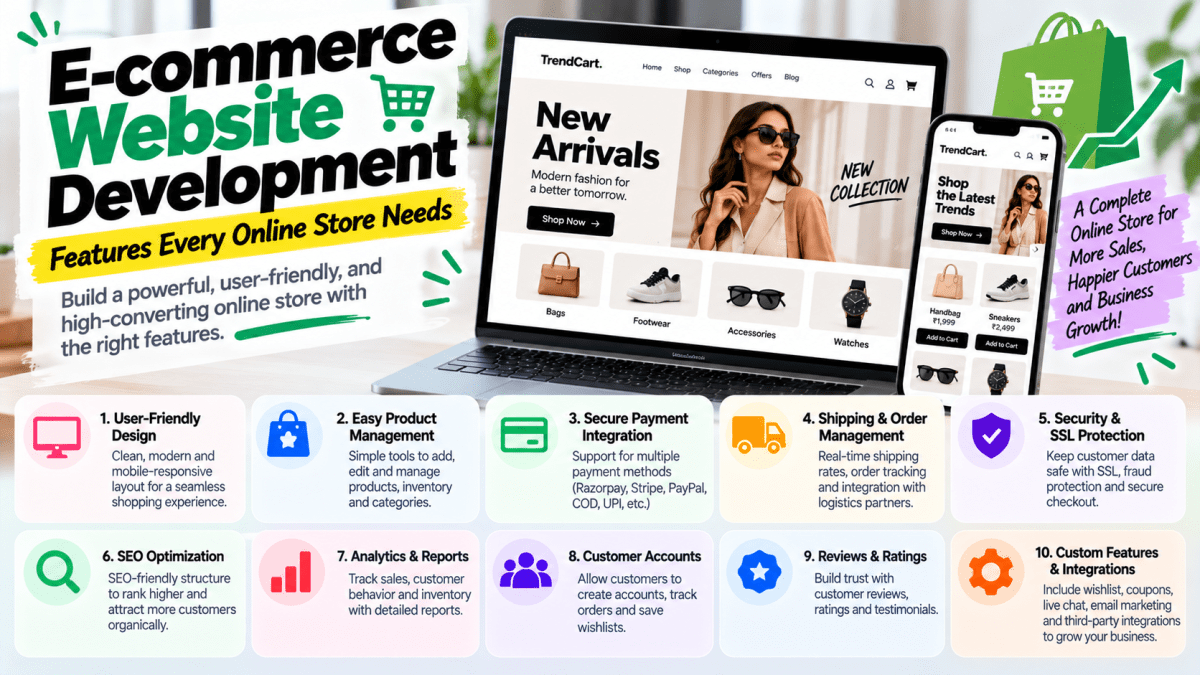
E-commerce#
Focus on:
- Product discovery
- Product photography
- Reviews
- Filters
- Search
- Checkout
- Offers
Professional Services#
Focus on:
- Expertise
- Credentials
- Case studies
- Testimonials
- Consultation CTA
Restaurants#
Focus on:
- Menu
- Food photography
- Location
- Reviews
- Reservations
- Ordering
Real Estate#
Focus on:
- Property listings
- Images
- Location
- Pricing
- Agent information
- Enquiry
Healthcare#
Focus on:
- Services
- Doctors
- Credentials
- Appointment booking
- Location
- Patient information
SaaS#
Focus on:
- Product value
- Features
- Demonstrations
- Pricing
- Integrations
- Signup
Professional design starts with understanding the customer.
22. Common Web Design Mistakes That Hurt Sales#
Even attractive websites can have conversion problems.
Here are some of the most common.
Too much information#
More content doesn't automatically mean more value.
Too many animations#
Animation should support the experience, not distract from it.
Generic messaging#
Visitors shouldn't have to guess what you do.
Weak CTAs#
"Learn More" isn't always the best action.
Poor mobile design#
A desktop-first website can create unnecessary friction.
Low-quality images#
Poor visuals can damage perceived quality.
No social proof#
Customers have no evidence that others trust you.
Difficult navigation#
Users can't find what they're looking for.
Slow performance#
Visitors leave before experiencing the website.
No clear differentiation#
The business looks exactly like every competitor.
Outdated content#
Old information can damage credibility.
Missing policies#
For relevant businesses, missing privacy, refund, shipping, or terms information can reduce confidence.
Professional Web Design vs Template-Based Design#
Templates aren't automatically bad.
A good template can be an excellent starting point for some businesses.
The problem occurs when a business simply installs a template and changes the logo.
A professional website should be adapted to:
- Brand identity
- Customer journey
- Business goals
- Industry
- Content
- Conversion strategy
- SEO
- Mobile experience
The question isn't:
"Did we use a template?"
The better question is:
"Does the website solve the customer's problem?"
How to Build a Trust-Focused Business Website#
Here's a practical framework.
Step 1: Define your target customer#
Know:
- Who they are
- What they need
- What they worry about
- What influences their decision
Step 2: Define your positioning#
Explain why customers should choose you.
Step 3: Build a clear information architecture#
Organize pages logically.
For example:
Home
About
Services
Portfolio
Case Studies
Blog
Contact
The exact structure depends on the business.
Step 4: Create a strong visual identity#
Define:
- Colors
- Typography
- Imagery
- Components
- Spacing
- Buttons
Step 5: Design mobile first#
Make sure the primary experience works on smartphones.
Step 6: Create strong content#
Design cannot compensate for weak messaging.
Step 7: Add proof#
Use:
- Reviews
- Testimonials
- Case studies
- Results
- Client logos
Step 8: Optimize conversion paths#
Make it easy to:
- Call
- Message
- Book
- Buy
- Request a quote
Step 9: Optimize performance#
Compress assets and reduce unnecessary code.
Step 10: Measure results#
Track:
- Traffic
- Engagement
- Leads
- Sales
- Conversion rate
- Form submissions
- Calls
- WhatsApp enquiries
A website should improve over time based on real data.
How to Measure Whether Your Website Is Actually Working#
A beautiful website isn't automatically a successful website.
You should measure business outcomes.
Important metrics may include:
Conversion Rate#
What percentage of visitors complete a desired action?
Lead Volume#
How many enquiries are generated?
Qualified Leads#
How many leads actually match your target customer?
Sales#
How many visitors eventually become customers?
Cost Per Lead#
How much does it cost to generate each lead?
Engagement#
Are visitors actually interacting with your content?
Mobile vs Desktop Performance#
Does one device category significantly outperform another?
Landing Page Performance#
Which pages generate the most conversions?
The objective is not simply:
"More website traffic."
The objective is:
More valuable business outcomes.
Website Design Is Part of Your Sales Process#
This is one of the most important ideas businesses should understand.
Your website isn't just a digital brochure.
It can perform parts of your sales process automatically.
A good website can:
- Explain your services
- Answer common questions
- Demonstrate expertise
- Display previous work
- Build trust
- Address objections
- Collect leads
- Sell products
- Book appointments
- Provide pricing information
- Direct customers to sales channels
In other words:
Your website can become a 24/7 sales assistant.
That's why investing in professional web design can have much greater value than simply improving aesthetics.
Professional Web Design and Brand Trust#
Trust isn't created by one element.
It's built through consistency.
A customer might see:
Professional logo
↓
Clear website
↓
Real portfolio
↓
Positive reviews
↓
Transparent information
↓
Easy communication
↓
Secure checkout/contact process
↓
Purchase
Every interaction reinforces or weakens trust.
Professional web design makes these interactions feel coherent.
How Stitchbyte Builds Conversion-Focused Websites#
At Stitchbyte, we believe your website should do more than exist.
It should help your business grow.
Our website development approach combines:
- UI/UX design
- Mobile-first development
- Responsive design
- Conversion-focused layouts
- SEO-friendly architecture
- Fast performance
- Professional branding
- Lead-generation systems
- WhatsApp integration
- Analytics
- E-commerce functionality
- Shopify development
- WordPress development
- Custom web applications
We start by understanding the business rather than simply selecting a template.
The objective is to build a website that communicates:
Who you are → What you offer → Why you're different → Why customers should trust you → What they should do next
That's the foundation of a high-performing business website.
Final Thoughts#
Professional web design isn't about making a website look expensive.
It's about making the business feel credible, understandable, valuable, and easy to work with.
Your website influences how customers perceive your company before they ever speak to you.
A professional website can:
- Build credibility
- Improve brand perception
- Reduce customer hesitation
- Improve user experience
- Increase engagement
- Generate more enquiries
- Support advertising campaigns
- Improve product presentation
- Make purchasing easier
- Strengthen your competitive position
But design alone isn't enough.
The best business websites combine:
Design + Content + UX + Performance + Trust + Conversion Strategy
That's where a website moves from being a digital brochure to becoming a genuine business asset.
Your customers are already judging your business online.
The question is:
What is your website telling them?
If your current website doesn't communicate the quality of your business, it may be time to redesign the experience.
Frequently Asked Questions#
How does web design build customer trust?#
Professional web design creates a consistent, clear, and credible experience. Elements such as branding, navigation, testimonials, case studies, professional imagery, transparent information, mobile usability, and performance can reduce uncertainty and make a business feel more trustworthy.
Can a good website increase sales?#
A well-designed website can improve the conditions for conversion by making information easier to understand, reducing friction, communicating value, and providing clear calls-to-action. However, sales also depend on factors such as product quality, pricing, market demand, traffic, and the sales process.
How important is mobile design for business websites?#
Extremely important. Many customers discover businesses through smartphones. A website that is difficult to navigate or use on mobile can create unnecessary friction and cause potential customers to leave.
What makes a website look professional?#
Professional websites typically have consistent branding, strong typography, good spacing, clear navigation, quality imagery, useful content, responsive layouts, fast performance, clear CTAs, and credible trust signals.
Should every business display pricing on its website?#
Not necessarily. Some businesses benefit from transparent pricing, while others require customized quotations. However, providing starting prices, package ranges, or an explanation of how pricing works can reduce uncertainty when appropriate.
How often should a business redesign its website?#
There is no universal timeline. A redesign should be considered when the website becomes difficult to use, outdated, slow, insecure, difficult to maintain, poorly optimized for mobile, or ineffective at generating business results.
Is WordPress good for professional business websites?#
Yes. WordPress can be an effective platform for professional websites when it is properly designed, developed, secured, maintained, and optimized. The quality of implementation matters as much as the platform itself.
Is Shopify suitable for professional e-commerce websites?#
Yes. Shopify provides a strong foundation for many e-commerce businesses. The store still needs effective UX, product presentation, mobile optimization, performance, conversion strategy, and branding.
How much does professional website design cost in India?#
Website pricing varies significantly depending on the project's requirements.
Factors can include:
- Number of pages
- Custom UI/UX
- Development technology
- CMS
- E-commerce functionality
- Integrations
- SEO
- Content
- Animations
- Custom features
- Maintenance
A basic business website and a custom e-commerce platform should not be expected to have the same development cost.
Should I hire a freelancer or a web development agency?#
It depends on the complexity of the project, budget, timeline, and level of support required.
A freelancer may be suitable for smaller projects.
An agency may be more appropriate when you need multiple capabilities such as UI/UX, development, SEO, content, integrations, marketing, and ongoing support.
The most important factor is not simply whether you choose a freelancer or agency.
It's whether the team can understand your business objectives and deliver a website that supports them.
Ready to Build a Website That Customers Trust?#
Your website is one of the most important digital assets your business owns.
If it looks outdated, loads slowly, doesn't work properly on mobile, or fails to communicate why customers should choose you, you're potentially leaving opportunities on the table.
Stitchbyte helps businesses build professional, responsive, SEO-friendly, and conversion-focused websites designed around real business goals.
From business websites and Shopify stores to WordPress websites, landing pages, and custom web applications, we build digital experiences that help businesses turn visitors into customers.
Stitchbyte — Let's Build Something Extraordinary.
Planning a Custom Website or Web App in 2026?
Avoid agency markups and hidden renewal fees. Speak with our lead architects for a transparent, itemized scope and architectural proposal tailored to your business goals.
Related Topics & Tags
Enjoyed this article?
Share it with your teammates or network.
StitchByte Team
AuthorPublished by the StitchByte engineering & design team. We build high-performance web applications, AI automation agents, and modern digital platforms for scaling businesses across India and globally.